
Leave a message for Paul.
Return to WKA Nationals start page.
Jeff Braun, pronounced brown, was my co-author on the book INSIDE RACING TECHNOLOGY. His sons Colin and Travis are starting their first year of serious kart racing as Tracc 5 Racing. Colin, 10 years old, is the driver. Travis, a year younger, is more interested in the data acquisition and mechanical aspects of racing. Diane, their mother, home schools them and acts as Race Mom as did Jeff's mother, Peggy, when he was a kid.
Jeff has engineered all kinds of racecars, and currently engineers for the Bradley Motorsports Indy Racing League team and driver, Buzz Calkins. Colin has driven quarter midgets with some success and now starts his kart career.
Jeff will send in reports during the World Karting Association National Championships in Charlotte, NC March 11 to 14. I should be able to post them with less than a day delay.
This is Colin driving in the Cadet Jr. Sportsman class at Jacksonville, Fla. last year. He makes that kart look big. We'll include some photos of the boys being boys in later reports.

Colin racing in the Yamaha Jr. Sportsman class at Jacksonville last year. The driver behind Colin is Lee Boss, the 1998 National Champion in this class.
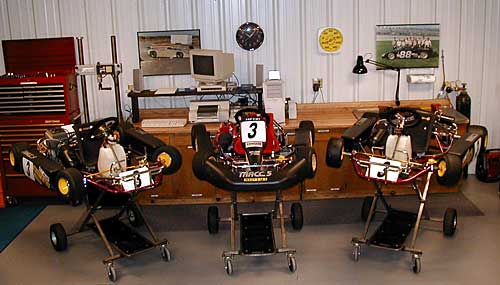
All 3 karts ready for the WKA Nationals in Charlotte March 11 to 14. How's this for Boy Toys? That workshop is way too clean.
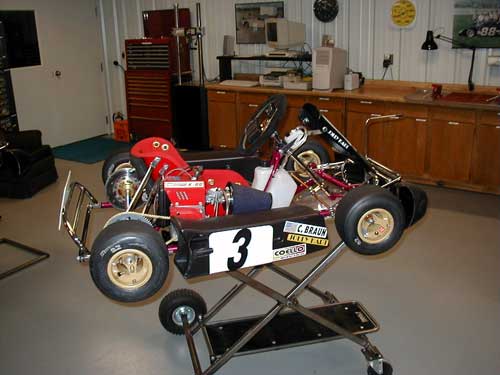
Cadet Jr. Sportsman class. The chassis is built by Jolly Kart - 35" wheelbase. The engine is a 80cc Comer 2-cycle engine that revs to 12,000 RPM and develops 8.5 HP. Transact uses engines built by GCT Engines. This class is for 8 to 12 year old drivers and runs worldwide. Top speed at Charlotte is 60 mph.
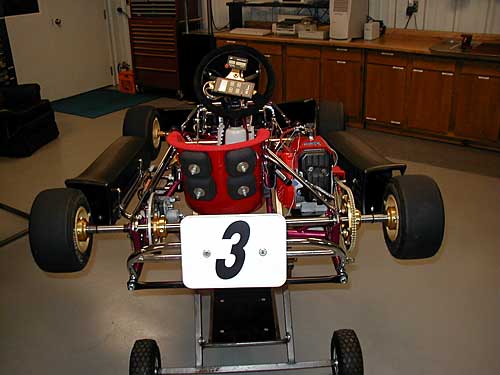
A rear view of the Cadet cart. Note weights bolted to the back of the seat. The kart must weigh 225 pounds minimum after each race including the driver. Placing the weights up high promotes weight transfer.The rear track is adjustable using the wheel hubs. Tires are Bridgestone YFC, a spec tire.
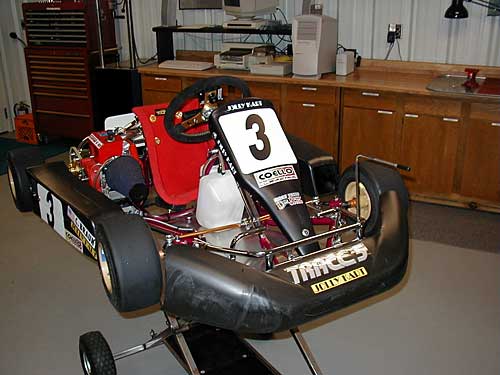
Here we see the front of the Cadet kart. Note the Pitot tube sticking out above the left front wheel. Jeff will use the Pi Engineering on-board data acquisition system to record air speed using the Pitot tube. They're trying to figure out the bodywork, how the nose and front fairing work. The Pitot probe provides a measurement of both static pressure and stagnation pressure, also called total pressure. Static pressure is just the pressure of the air at a point measured perpendicular to the flow. The total pressure is the pressure of the air after it has been stopped from some speed and is higher than the static pressure by the amount of momentum in the air. The speed of the kart through the air is proportional to the difference between the two measurements, static and total. Small holes through the bodywork act as static pressure taps and measurements there can be compared to the static pressure in undisturbed air at the pitot tube.
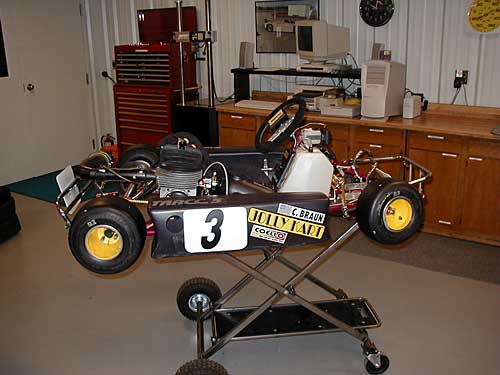
This is the kart Colin drives in the HPV Jr. Sportsman Class. It's a Jolly Kart Step 1 with a 40" wheelbase, designed for adult drivers. Jeff modified the driver controls to fit Colin. This size kart is required in this class by WKA Tires are Dunlop SL4, again a spec tire.
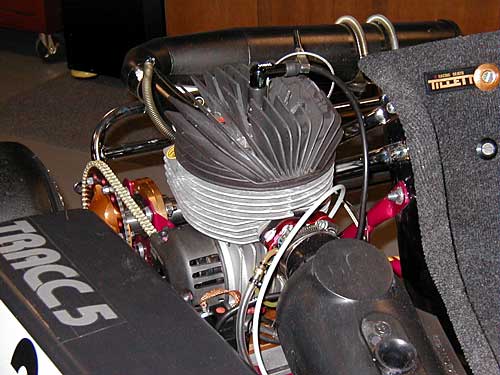
The HPV (Horstman Piston Valve) 2-cycle engine has 100cc swept volume and turns 14,000 RPM developing 9.5 HP. This engine is built by Woltjer Engines and is engine is used by all age groups. Classes for older drivers allow larger carbs and exhaust pipes. In the top class this HPV engine will rev to 17,000 rpm and produce 20 HP. Note the black box on the carb. This is an intake silencer. Half the noise from a two-stroke engine comes from the intake. The inlet silencer is required by WKA. The clutch is a dry single-plate centrifugal clutch that locks up at about 6,000 rpm. It works like a Top Fuel dragster clutch.
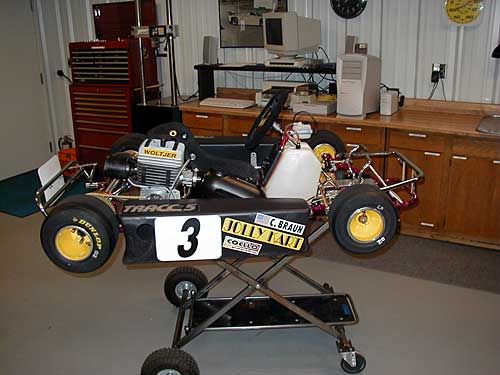
Colin's Yamaha Jr. Sportsman Class kart is also made by Jolly. It's a Step 1 - 40" wheelbase - designed for adult drivers. The driver controls are modified to fit Colin. This size kart is required in this class by WKA. Tires are Bridgestone YFC, a spec tire.
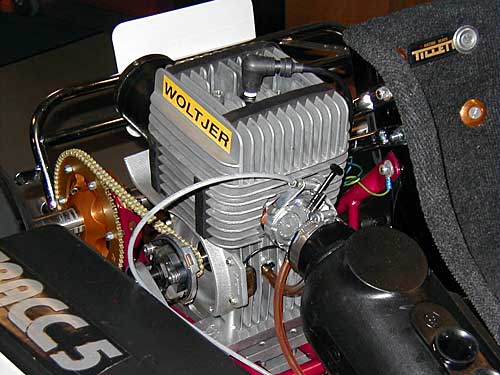
The Yamaha engine is a 2-cycle, 100cc, piston-port design. It turns 12,000 RPM max and puts out 8 HP. This one is built by Woltjer Engines. It has a restrictor plate behind the carb and a "can" muffler (no tuned pipe) to lower the power for the Sportsman drivers. In the next class (12 to 16 years - called Junior) they remove the restrictor. When the drivers reach 16-and-over class (called Senior) they run no restrictor and a tuned exhaust pipe. That configuration will produce 20 HP. The clutch is a dry single-plate centrifugal clutch.
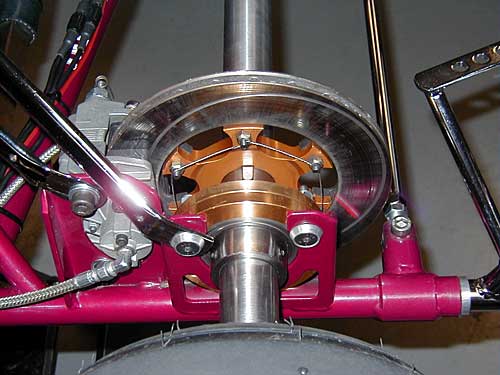
This photo shows the Jolly Kart brake detail, a dual-piston, vented-rotor, disk-brake system. Notice the quality of the parts. These are not play toys!
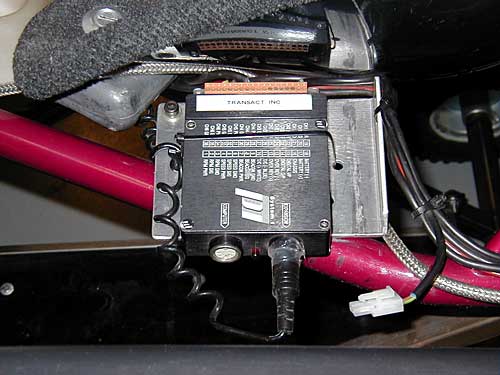
Here we have a Pi Engineering System 1 mounted on the Yamaha kart. This is a 16 channel data acquisition system that logs throttle position, air speed, RPM, cylinder head temperature, exhaust gas temperature, lateral acceleration, steering position, and lap times. The software has setup sheets and will draw track maps and show segment times. It has math channels for data analysis and will generate histograms or line graphs.
Notice the open port for plugging in the laptop computer to download
data. The data system is the responsibility of Travis Braun, 9
years old. He may be the youngest DAG (Data Acquisition Guy) in
the sport. The plug and curly line coming out is for the mini-dash
that displays lap times and engine temperature. Colin tunes the
carb mixture as the kart is running based on the engine temperature,
the sound of the engine, and how it feels to him.
The white plug at the lower right of the photo is for battery which is not shown.
Any questions? You know something I don't know?
Leave a message for Paul.